
How to Choose a Commercial Fryer
A practical commercial fryer buying guide for restaurants, takeaways, hotels, cafés, pubs and fast food kitchens — covering capacity, gas vs electric, tank configuration, filtration, safety and lifecycle cost.
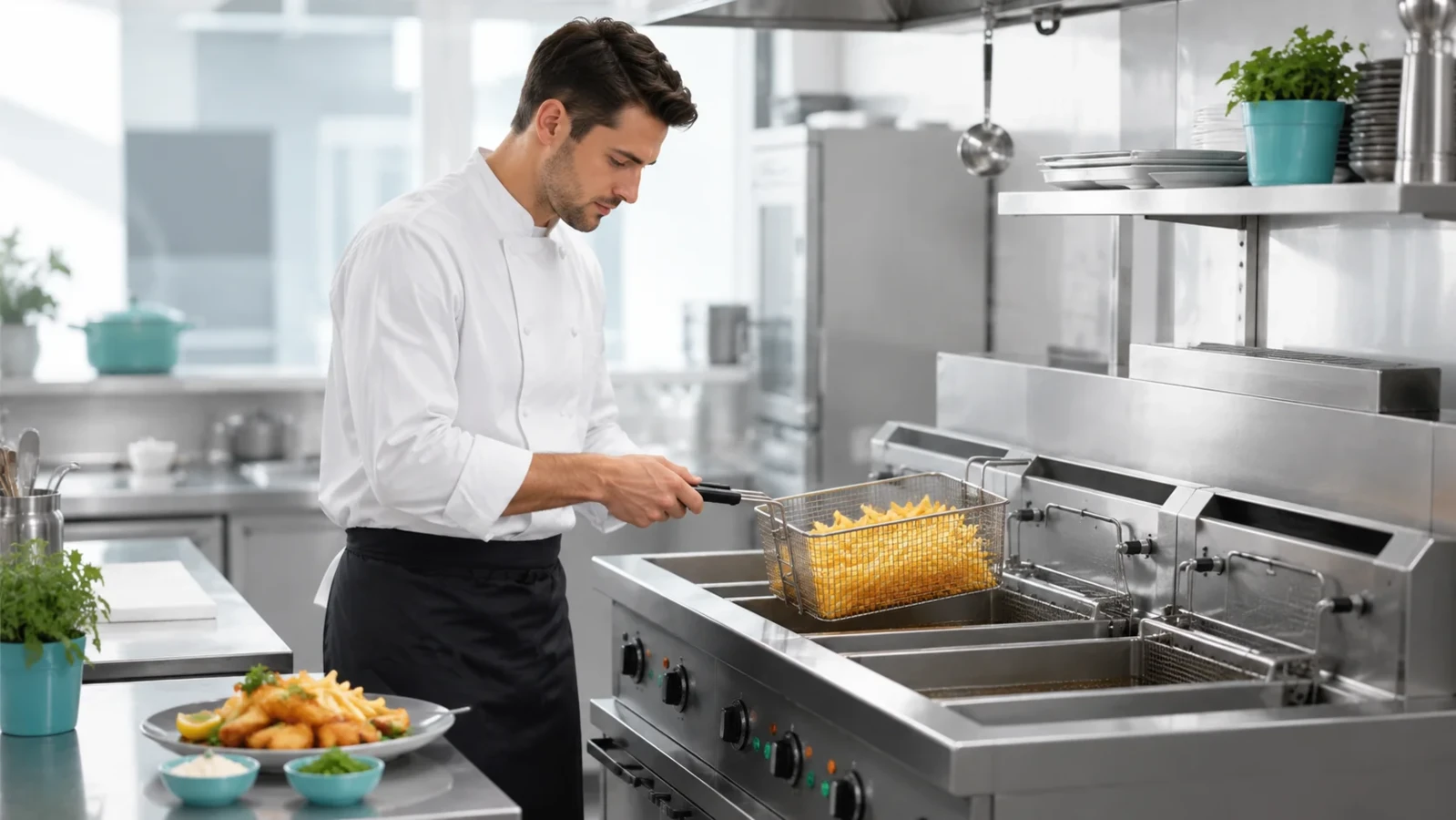
Choosing a commercial fryer is not just about buying the biggest or cheapest model available. The right fryer affects food quality, service speed, energy use, oil costs, kitchen safety and long-term operating margins.
Whether you run a fish and chips shop, fast food outlet, hotel kitchen, café, pub or restaurant, this commercial fryer buying guide will help you choose the right size, tank configuration, power source and filtration setup for your operation.
In this guide, we will cover fryer capacity, single tank vs double tank fryers, gas vs electric commercial fryers, oil filtration, HACCP and safety considerations, lifecycle costs and recommended fryer types for different foodservice use cases.
Need help choosing faster? Browse commercial fryers, or request a quote for a tailored recommendation.
Why the Right Commercial Fryer Matters
A commercial fryer is one of the most demanding pieces of equipment in a professional kitchen. It works at high temperature, consumes significant energy, uses expensive frying oil and often operates during peak service.
A poorly chosen fryer can create slow recovery time, inconsistent food quality, higher oil consumption, increased energy costs, longer cleaning routines, cross-contamination between food types, bottlenecks during lunch or dinner rush and safety risks around hot oil handling.
A well-selected fryer does the opposite. It keeps oil temperature stable, supports your expected covers per day, separates food types where needed, reduces oil waste and fits your kitchen layout, extraction system and HACCP procedures.
Before choosing a model, start with the operation. Do not begin with the fryer size — begin with the menu, service volume and workflow.
Step 1: Estimate Your Frying Volume
The first question is simple: how much fried food do you need to produce during your busiest period?
Many kitchens make the mistake of calculating fryer capacity from daily covers only. Daily covers matter, but the real pressure happens during peak service. A restaurant serving 120 covers per day may only need moderate frying capacity if fried items are occasional side dishes. A takeaway serving 80 covers in two peak hours may need a much more powerful fryer.
Start with three numbers: covers per day, percentage of orders including fried food and peak-hour concentration. These three figures give a more realistic view than a simple daily cover count.
As a practical starting point, occasional frying may need small oil capacity of around 5–8 litres. Regular side dishes often need 8–15 litres. Main fried menu items may need 15–25 litres, while dedicated fried food businesses usually need multiple tanks or larger floor-standing units.
Oil capacity is not the same as production capacity, but it is a useful first indicator. A larger tank has more thermal mass, which helps temperature stability. However, bigger is not always better. A fryer that is too large for the workload wastes oil and energy.
| Operation | Covers/day | Fried item share | Peak demand | Fryer requirement |
|---|---|---|---|---|
| Small café | 40–80 | Low | Moderate | Countertop electric fryer |
| Pub / bistro | 80–150 | Medium | Medium–high | Floor-standing single or double tank fryer |
| Fast food | 150–400 | High | High | High-output double tank fryer |
| Fish & chips | 100–300 | Very high | Very high | Large capacity fryer with strong recovery |
| Hotel breakfast / buffet | 100–250 | Medium | Short peak window | Multiple baskets or double tank fryer |
Step 2: Match Oil Capacity to Your Menu
Different foods create different fryer demands. Frozen fries are predictable and usually easy to manage. Breaded chicken, battered fish, onion rings and mozzarella sticks create more crumbs and oil contamination. Freshly battered products can reduce oil quality faster and require more careful filtration.
For light frying — small portions of fries, occasional side dishes, frozen snacks or starters — a compact countertop fryer may be enough, especially in a café, small pub or low-volume kitchen. A model like the Combisteel Base 600 10L electric tabletop fryer typically suits this profile.
For medium frying — fries served with many dishes, chicken strips, calamari, croquettes, fried starters and lunch menu sides — a larger electric fryer or floor-standing fryer is usually more appropriate. A single large tank may work, but a double tank often gives better workflow.
For heavy frying — fish and chips, fast food, fried chicken, high-volume fries and takeaway operations — strong recovery time, high oil capacity and often separate tanks are essential. For heavy-duty frying, compare models by oil capacity, power output and basket configuration. A floor-standing unit such as the Combisteel Base 700 dual-tank gas fryer (2×15L) handles this load.
Step 3: Single Tank vs Double Tank vs Split Tank Fryer
One of the most important decisions is the tank configuration. A single tank fryer has one oil tank, usually with one or two baskets. It is suitable when you fry mostly one type of food, the kitchen has limited space, you want a simpler lower-cost setup and cross-flavour transfer is not a major issue.
A single tank fryer is often a good choice for smaller restaurants, cafés and pubs where fries are the main fried item. The downside is flexibility. If you fry fish, chicken and fries in the same oil, flavours can transfer. Crumbs and batter from one product can also shorten oil life for everything else.
A double tank fryer has two separate oil tanks. This is one of the most versatile options for professional kitchens. It is suitable when you fry different food types, want to separate fish, meat and vegetarian items, need more output during peak service or want to continue service if one tank is being filtered or cleaned.
For many restaurants, a double tank fryer is the safest all-round choice. A typical setup is one tank for fries and potato products and the second tank for fish, chicken, starters or battered products. This helps protect oil quality and improves consistency.
A split tank fryer gives smaller separate tanks within a compact footprint. It is useful when you need separation but not always maximum output. It can be excellent for restaurants, cafés and hotel kitchens where the fried menu is diverse but not extremely high volume.
| Requirement | Best option |
|---|---|
| Mostly fries, low-medium volume | Single tank |
| Fries + fish or chicken | Double tank |
| Vegetarian separation needed | Double tank or split tank |
| High-volume takeaway | Double tank floor-standing fryer |
| Limited space, varied menu | Split tank |
| Lowest purchase cost | Single tank |
| Best operational flexibility | Double tank |
Step 4: Gas vs Electric Commercial Fryer
Another major decision is whether to choose a gas or electric commercial fryer. There is no universal winner. The right choice depends on your building, energy prices, extraction system, service volume and installation options.
Electric fryers are common in restaurants, cafés, pubs, food trucks, small kitchens and locations where gas installation is not practical. They can offer easier installation in many sites, precise temperature control, suitability for smaller kitchens, a wide range of countertop models and more flexible placement.
The disadvantages of electric fryers are mainly connected to power supply. High-output models can need three-phase power, and running cost depends heavily on local electricity prices. Recovery time also varies by model and power rating.
Gas fryers are often used in high-output kitchens where strong recovery and heavy service are important. They are often preferred for high-volume frying, can be economical where gas prices are favourable and suit busy takeaways and fast food operations. A unit like the Combisteel Base 700 15L gas freestanding fryer is a typical workhorse for fish & chips or fast food.
Gas fryers require gas installation, careful ventilation and appropriate servicing. They are not suitable for every building. Before choosing, compare not only the purchase price but also installation cost and available utilities. A cheaper fryer can become expensive if the site needs electrical upgrades or gas work.
| Factor | Electric fryer | Gas fryer |
|---|---|---|
| Installation | Usually simpler | Requires gas connection |
| Best for | Small to medium kitchens, flexible sites | High-volume kitchens |
| Temperature control | Often very precise | Strong performance on heavy models |
| Energy cost | Depends on electricity tariff | Depends on gas tariff |
| Site requirements | Electrical capacity | Gas safety, ventilation |
| Mobility | More flexible | Less flexible |
| Upfront planning | Lower | Higher |
Step 5: Understand Recovery Time
Recovery time is the time a fryer needs to return to the correct oil temperature after food is added. This is critical.
When frozen fries or battered fish enter the oil, the temperature drops. If the fryer cannot recover quickly, food absorbs more oil, becomes greasy and takes longer to cook. Slow recovery also reduces peak output and can create queues in the kitchen.
A fryer with strong recovery helps produce crispier food, faster service, more consistent results, lower oil absorption and better peak-hour throughput.
When comparing models, do not look only at oil capacity. Compare power output, tank size, basket size, recovery performance, intended use and whether the fryer is countertop or floor-standing. For fish and chips, fast food or takeaway service, recovery time is one of the most important buying criteria.
Step 6: Oil Filtration and Oil Life
Frying oil is a major ongoing cost. The fryer purchase price is only one part of the real cost. Oil quality affects taste, food appearance, smell, operating cost and HACCP routines.
Oil breaks down faster when exposed to crumbs, batter particles, high temperatures, oxygen, water from frozen food, mixed food types and poor filtering routines.
Manual filtration usually means draining the oil, passing it through a filter system and cleaning the tank manually. It has a lower upfront equipment cost and can work well in lower-volume kitchens, but it takes more labour and increases risk when handling hot oil.
Built-in filtration allows oil to be filtered more easily, often as part of the fryer system. It can make filtration faster, easier to perform regularly, extend oil life, improve food consistency and reduce manual handling of oil. The trade-off is a higher purchase price and more parts to maintain.
Built-in filtration becomes more attractive when you fry every day, oil consumption is high, the menu includes breaded or battered products, oil changes are frequent or consistent food quality is essential. Even a small reduction in oil changes can create meaningful annual savings when you include oil cost, labour and downtime.
Step 7: HACCP, Safety and Cleaning
A commercial fryer must fit your HACCP procedures and kitchen safety standards. Hot oil is one of the highest-risk materials in the kitchen. A good fryer should make daily operation, draining, cleaning and temperature control as safe and repeatable as possible.
A drain valve makes oil removal easier and safer. Without a proper drain system, staff may need to lift or pour oil manually, which increases risk. For medium and high-volume kitchens, a drain valve is strongly recommended.
Oil temperature consistency is important for both food safety and quality. Poor control can lead to undercooked food, burnt oil or inconsistent batches. Look for models with reliable temperature control and clear operating settings.
Some fryers include a cold zone where food particles fall below the main cooking area. This helps reduce burning crumbs and can extend oil life, especially for breaded and battered products.
Fryers usually require suitable ventilation and extraction. The exact hood capacity depends on fryer type, heat load, cooking volume and local regulations. Before installation, confirm hood size, extraction capacity, fire suppression requirements, gas safety rules if using gas, electrical load if using electric, clearance around the fryer and local building and food safety requirements.
Step 8: Calculate Lifecycle Cost
A commercial fryer should be evaluated by lifecycle cost, not just purchase price. The true cost includes purchase price, installation, oil usage, energy consumption, filtration labour, cleaning labour, maintenance, downtime and food waste from inconsistent frying.
A cheaper fryer may cost more over time if it uses oil inefficiently, recovers slowly or requires frequent service. For a low-volume kitchen, a simple fryer may make financial sense. For a high-volume takeaway, spending more on capacity, recovery and filtration can be the better business decision.
Use the energy cost figures shown on each fryer product page to estimate the long-term operating difference between models. The goal is not to find the largest fryer, but the fryer with the best fit between performance, cost and kitchen workflow.
| Cost area | Why it matters |
|---|---|
| Purchase price | Initial investment |
| Installation | Gas, electricity, ventilation |
| Energy | Daily running cost |
| Oil | Major recurring cost |
| Labour | Filtering and cleaning time |
| Maintenance | Parts and servicing |
| Downtime | Lost service capacity |
| Food quality | Customer satisfaction and repeat sales |
Recommended Fryer Types by Use Case
Fish and Chips Shop
A fish and chips operation needs strong output, stable temperature and oil separation. Battered fish creates particles and affects oil quality, so filtration and tank separation are important.
Recommended setup: floor-standing fryer, double tank or multiple tanks, strong recovery time, drain valve, filtration support and robust stainless steel construction.
Best choice: high-output double tank fryer like the Combisteel Base 700 dual-tank gas fryer (2×15L), especially if fish and chips are the core menu.
Fast Food and Takeaway
Fast food kitchens need speed, repeatability and volume. Fries, chicken, nuggets and snacks may need separate tanks to avoid flavour transfer and improve workflow.
Recommended setup: double tank fryer, high recovery performance, multiple baskets, easy draining, oil filtration if used daily and a floor-standing model for higher output.
Best choice: double tank floor-standing fryer with strong recovery — the Combisteel Base 700 electric 2×10L handles a busy chicken / fries split well.
Restaurant À-la-Carte Kitchen
A restaurant usually needs flexibility more than extreme volume. The fryer may handle fries, starters, fish, vegetarian items and occasional specials.
Recommended setup: single large tank if frying is limited, double tank if the menu is varied, split tank if separation is important but space is limited, accurate temperature control and easy cleaning.
Best choice: double tank or split tank electric fryer for flexibility — see the Combisteel Base 600 electric 2×10L.
Hotel Breakfast or Buffet
Hotels often have intense short service windows. Fried items may include hash browns, sausages, bacon-style items, croquettes or breakfast sides.
Recommended setup: double basket configuration, medium oil capacity, fast recovery for short peak periods, easy cleaning and electric installation if the kitchen layout requires flexibility.
Best choice: medium-capacity double tank fryer or two smaller fryers for workflow separation. See the Hotel breakfast buffet solution for a complete equipment list.
Small Café or Bar
A small café may only need a compact fryer for snacks, fries or occasional side dishes.
Recommended setup: countertop electric fryer, 5–8 litre oil capacity, simple controls, easy cleaning and low footprint.
Best choice: compact countertop electric fryer like the Combisteel Base 600 10L electric tabletop. The Café starter kit bundles this with the rest of a small café line-up.
Common Mistakes When Buying a Commercial Fryer
Buying Only by Price
The cheapest fryer may be suitable for light use, but it can become expensive if it slows service, wastes oil or fails under pressure.
Underestimating Peak Demand
Daily covers are less important than peak-hour frying demand. Always calculate the busiest 60–90 minutes.
Ignoring Oil Management
Oil is a recurring cost. If you fry daily, filtration and cleaning routines matter as much as the fryer itself.
Mixing All Food Types in One Tank
Fish, chicken, vegetarian items and fries may need separation. A double tank fryer can prevent flavour transfer and improve oil life.
Forgetting Installation Requirements
Gas, electricity and extraction requirements can change the real cost of the fryer. Confirm site conditions before ordering.
Choosing Too Large a Fryer
Too much oil capacity can waste energy and oil if the kitchen does not use it. Bigger is not always more efficient.
Quick Buying Checklist
- How many covers do you serve per day?
- How many fried portions do you serve during peak hour?
- Are fried foods a side dish or a core menu item?
- Do you need to separate fish, meat, fries or vegetarian items?
- Is gas available, or is electric more practical?
- Do you have enough electrical capacity?
- Does your extraction system support the fryer?
- How often will you filter or replace oil?
- Do you need built-in filtration?
- What is the total lifecycle cost, not just the purchase price?
When in doubt, choose the fryer based on workflow, not catalogue size.
Related Resources
Ready to buy?
Talk to our team — we'll help you spec the right equipment and prepare a B2B quote.